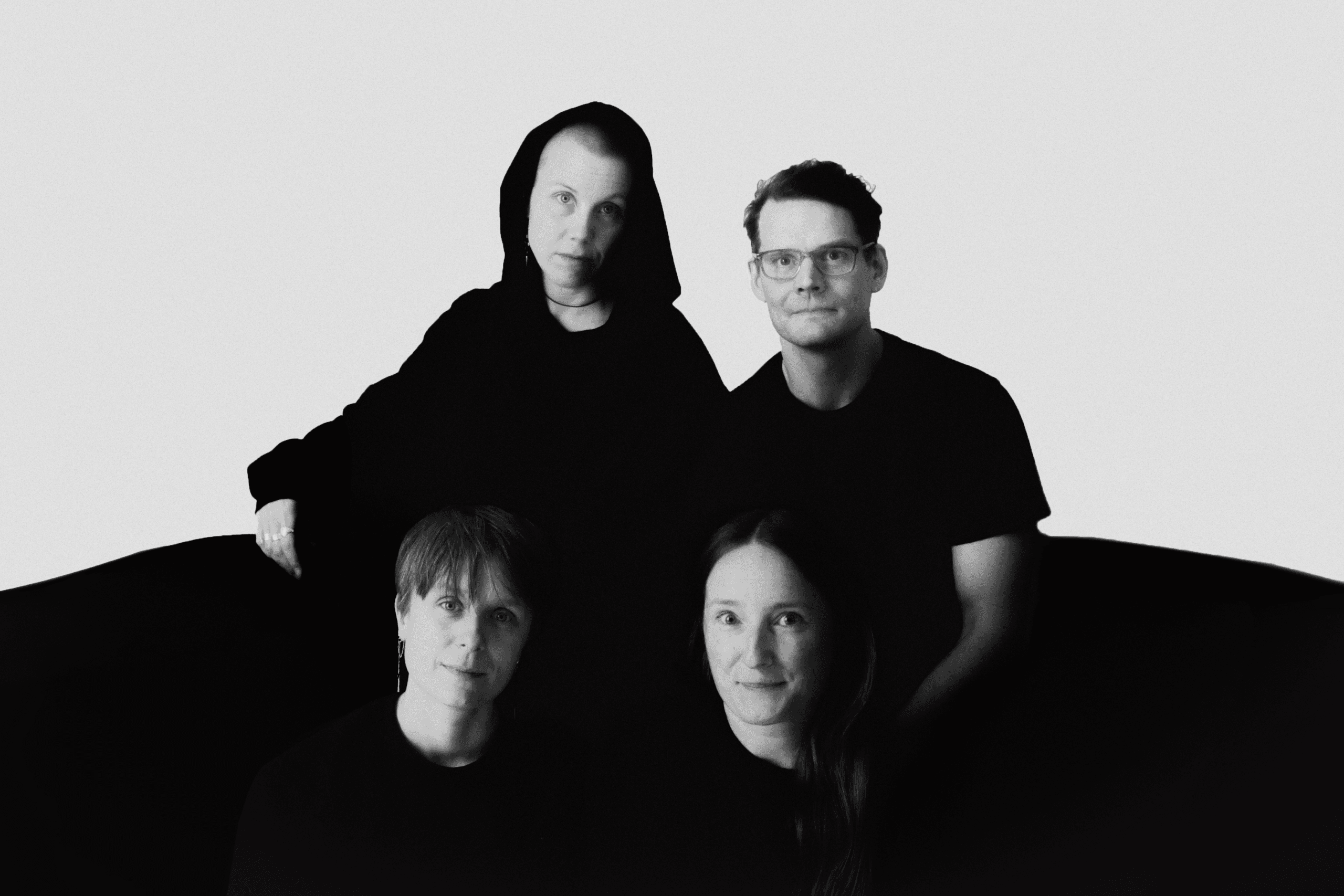
2026 ARTIST INTERVIEW • NIGHTSCHOOL may be unlike any other contemporary performance piece. Few details emerge from the otherwise hushed production; it runs for 15 hours overnight, while the venue, main partners, and artistic collaborators remain secret until the audience’s arrival. What is public is its core premise (an overnight journey helping us practice togetherness on a changing planet) and the collective behind the performance.
Milla Martikainen, Maija Nurmio, Pauli Riikonen and Essi Rossi are artists whose work stems from the reality of the ecological crisis. They have collaborated together on various projects, including earlier editions of NIGHTSCHOOL, for more than 10 years.
NIGHTSCHOOL, as both performance project and artistic collective, is based on the idea that collective transformation requires both personal unlearning and opening ourselves up to what we do not yet know. The format calls back to the school sleepovers many of us may recall from childhood, where an otherwise familiar place took on an unfamiliar quality, and everyone ended up in sleeping bags, talking past bedtime. Another core tenet is to prompt attendees’ thinking around larger societal topics, and to embrace the sort of personal transformation that may only be found in the night.
To better understand the transformative powers of the dark, I spoke with the collective about their upcoming performance and its origins.
Helmi DeMaxi: What was the first spark that created NIGHTSCHOOL, both as a collective and performance format?
Essi Rossi: There’s no NIGHTSCHOOL without the reality of ecological crisis and urgency to make a collective change towards more sustainable life. That has always been our why.
Maija Nurmio: What sparked NIGHTSCHOOL in the first place was a deep, shared desire to keep learning, both together and from one another. This desire to learn kept bringing us back to the rehearsal space, initially with no real intention of making a performance, but simply to remain curious and explore together. Gradually, the idea of NIGHTSCHOOL as a performance began to take shape.
Milla Martikainen: The condition we work and live in has changed during this decade and the performance has changed with it, but the basic idea of taking time and space to be with the trouble, and making use of the energy and mindset of the night time compared to the hustle of daytime consciousness is something that has been with us from the start.
HD: How has NIGHTSCHOOL changed since the first time you staged it?
ER: There’s a lot that evolves and grows from performance to performance. What changes is something that changes in us, in the world and in the performing arts. Ten years ago in the first NIGHTSCHOOL there was much more hope in the air, much more trust in political action. It felt at the time that finally everyone understood the urgency and that we’d build a more sustainable future together. Little did we know.
Then, in the middle of the pandemic in 2021, in the second NIGHTSCHOOL, we played with the safest spaces we knew, and the performance turned towards practices of care and rituals. Now we are stepping to the night in the reality of genocide, and the wild, wild west of politics and AI. We are yearning for more meaningful and deeper experiences, and we want to create space for that. In this edition we praise the unknown, the danger, the action, the whimsiness and connections.
MM: The core idea of taking time, overnight, and working with the conditions of transformation with invited guest artists has stayed. We’ve oscillated the emphasis between the communal and individual, and how the condition of polycrisis is affecting how we want to formulate our material.
HD: You mentioned that you’ve talked to an evolutionary biologist about network theory and the need for communal mourning rituals in preparation for NIGHTSCHOOL. Can you reveal more about topics, concepts, or themes that may come up at the performance this year?
ER: Talking to experts has been an elemental part of our way of working since the beginning. We are fans of Aura Raulo and we asked for a meeting because of her research and experience with networks, dying, loss, and change. We were deeply influenced by her way of looking at things. One can actually feel the influence in the performance. The most important collaborators and experts are the audience, the ones that come together to share the journey. That’s why we’re inviting people from all different areas of life and society to join us.
MM: For me personally the philosophy of Donna Harraway (staying with the trouble) and Joanna Macy’s words of pain and love being twins have been central to how I work in the condition of polycrisis.
ER: We are now also more courageous with the audience than before, I must say. We have moved towards braver spaces, braver thinking, braver action. Even though NIGHTSCHOOL is kind of like a nighttime spa or a bit of a weird staycation, it gives me joy to address the urgency and seriousness of the situation and work with it.
HD: Why are experimental and communal spaces like NIGHTSCHOOL needed?
MM: It’s important that ambitious and experimental art is part of creating and framing these spaces of being with the messy present and unknown future. Performance has a special power of bringing people physically together for a set amount of time and nudging our reality.
MN: These kinds of spaces, and the time they make possible, allow for a more sensory and corporeal experience to emerge and be held collectively. I think there is something potentially revolutionary about finding a collective, embodied way of living with and processing worry.
HD: Is there something special about performing overnight that wouldn’t be possible in daylight? What’s the magic in the format?
ER: Darkness has always been essential part of NIGHTSCHOOL. We carry long history with the fear of darkness, our imagination and instincts awaken in the dark, darkness does tricks on us on a cellular level, and, there’s something forbidden in the dark. But one can also hide in the dark, lose track of time in the dark, and dream.
MN: Nighttime allows for a more vivid sensory and embodied experience than daytime, as our bodies naturally begin to slow down in response to the fading light. From a restful place, we can be more connected to our and others needs, become more observant and curious, let go and dare to imagine otherwise. This lands us in a very fruitful state – the opposite of absence. Nighttime brings an essential quality to the work.
HD: You’re deciding to keep the main partners, including those providing a beautiful venue and food, undisclosed until participants arrive. Why the mystery? Is there anything you can reveal already?
ER: We think that the mystery, or not-knowing as we call it, is a huge part of the atmosphere and mindset in the performance.
MM: Yeah, accepting to surrender to the unknown and letting go is a material we work with in the performance. Deciding to buy the ticket and join us for this journey is the first act that tunes you towards what’s to come.
* * *
Are you looking to embrace the unknown? Just a few last-minute tickets remain to NIGHTSCHOOL this weekend. Get yours here.