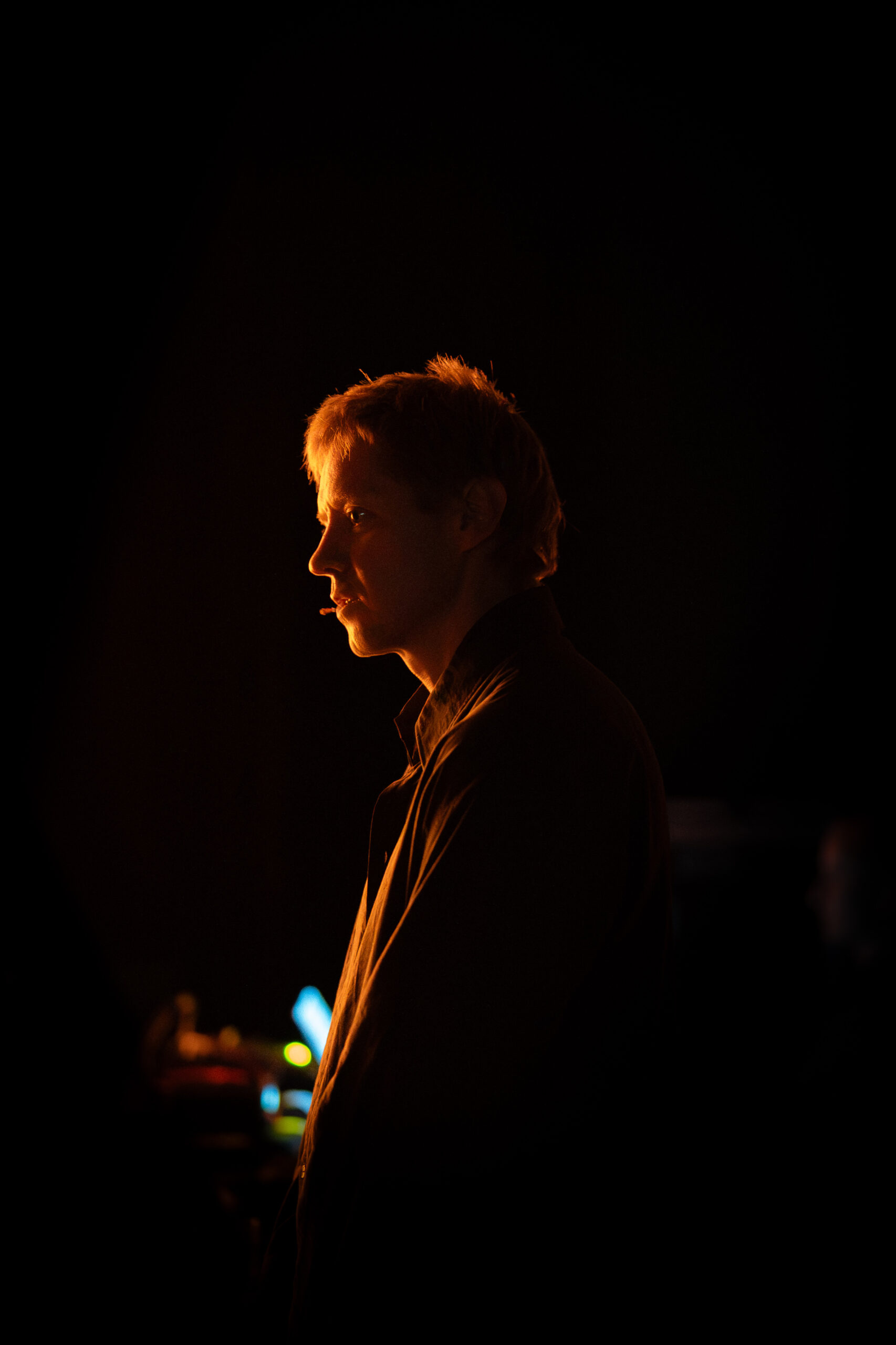
2026 ARTIST INTERVIEW • Paris-based artist, researcher, and trained hypnotherapist Aapo Nikkanen's work focuses on hypnotic performances and photography.
When I first met him, he hypnotized me. Among a small audience, lounging in lawn chairs placed in a leisurely circle, Aapo’s voice guided us into a state of trance.
I remember a small lamp dangling in the darkness, our eyelines tethered to its changing colours – then the pitch black of my own closed eyelids. At some point, a completely unrelated childhood memory was conjured into my mind’s eye by what Aapo describes as metaphorical storytelling¹. What I was experiencing was the first part of his soon-to-culminate performance trilogy: a project called Joy Machines, staged at New Performance Turku Biennale in September 2025.
Aapo’s practice and three-part project exploring cognitive art has evolved since then. With its final installment, Tranceformer, set to premiere at Baltic Circle on November 26th, I sat down with him to discuss the performance and his practice more widely:
Helmi DeMaxi: Could you describe the process of creating Tranceformer? What sparked the first idea?
Aapo Nikkanen: It started with a fairly simple idea: thinking about the unconscious as something that isn’t neutral. It’s a site of influence and extraction. Maybe more than ten years ago you could think of it as more neutral territory, but it definitely isn’t anymore, especially with the influence of contemporary technology.
We’ve had algorithmic feeds for about ten years now, and we know they affect us: they’re addictive, they cause anxiety and hurt our concentration. My question with Tranceformer is what happens next, when these AI systems — which are still mostly text-based — become these human-like conversational entities. They can sound extremely human, and even knowing they’re not human doesn’t mean our unconscious will actually register that fact. I don’t think we evolve that fast.
HD: How does hypnosis tie in?
AN: The idea of using hypnosis came from that initial question: if these dynamics are already happening in the cognitive sphere with tech, then maybe art could also operate within that space — using cognition itself as a medium. What if an AI could hypnotize a person, using the medium itself as part of the message?
HD: We’re seeing a lot of conversation, both critical and enthusiastic about the AI boom. Are there any other perspectives that have influenced the creation of this piece?
AN: My original angle was actually about how natural resources are used by AI infrastructure to build things we don’t really have control over. We have these consumer-facing large language models, but that same infrastructure is also used for much more sinister purposes like surveillance and warfare.
I’m from Kirkkonummi, where Microsoft is building a massive data center. Most of our drinking water comes from a nearby nature reserve. Water from that same source will also be used to cool the data center.
So our local natural resources end up supporting systems that are owned and controlled elsewhere. Those systems have benign uses, but they’re also used for violence and surveillance around the world. My first thought was, could I find a way for people to experience that connection? My first idea was: could that be somehow made experiential?
I’ve felt that angle is quite heavy, since I still want the audience to have a positive experience. So I’ve gone deeper into the cognitive side of it for now. Our cognition becoming a site of contestation feels like genuinely dangerous door opening, in terms of influence and manipulation.
HD: Is there a common misconception about hypnosis or hypnotherapy that you would like to correct?
AN: Some people fear they will lose control or power, but it doesn’t work like that – you won’t turn into a chicken or lose your memory. These are misconceptions created by stage hypnosis and TV.
Of course there are effects that happen: time distorts, and may feel faster or slower. There are also a few medical applications, like analgesia ², that can be achieved in deeper levels of trance. Hypnosis is a trance state, and trance states are completely natural phenomena.
Most people have never experienced a trance state before. The state itself, regardless of content, is already a huge part of the experience. Trance is a completely different kind of attentional space from where we usually are: deep concentration and focus, but structured differently.
HD: Can you tell me more about your collaboration with sound designer Raudie McLeod?
AN: We’ve been working together for a while. He’s extremely talented, and it’s almost mind-blowing how fast he works, and how good his ideas are. The more we collaborate, the better it gets, and the more ideas come out of it.
What’s remarkable is how much shifts in ambience can affect the trance state itself. There’s emerging research on how differently we perceive sound while in these altered states. It becomes a kind of feedback loop: once people are in trance, sound feels different to them, so the music itself can shift slightly in response, to reinforce that feeling. The sound design is a core part of how the piece functions.
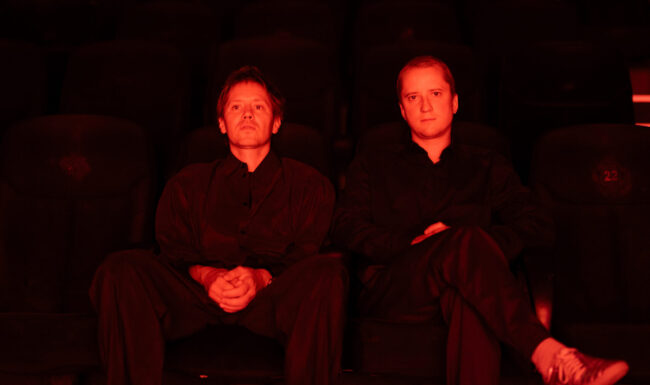
HD: You’ve built your own conversational AI agent for this piece, rather than using one with a pre-tuned personality. The final performance will see you on stage in conversation with it. What did that process involve?
AN: It’s honestly kind of crazy how fast this space is moving. What I started with and what I have now are completely different things. When I began, I thought I’d need a whole team to build the technology. Now I can just do it myself using an app, or even build an app myself, without help. It’s wild.
From the beginning, I thought of the AI as an actor that improvises up to a point, and then doesn’t. That was my first intuition, and it seems to have held up well.
HD: So will the conversation between you and the AI be pre-planned or emerge spontaneously?
AN: It’s going to be somewhere in between. I have a few different paths I’m exploring. I’m really approaching this the way I’d write a theatre or performance piece: usually my work is very structured but I improvise what I say when speaking alone, but now I’m speaking with someone else. There will be a ‘person’ next to me who knows everything they need to know. It will be a mixture of conversations and taking turns.
✧ ~ ◦ ꩜ ◦ ~ ✧
Speaking with Aapo, it’s clear that he sees the unconscious as increasingly contested ground: algorithmic feeds already shape our attention, and AI systems may soon do the same via human-sounding chat companions and other emerging technologies. Yet, as is often the case with artists, his curiosity is driven just as much by an appreciation for beauty.
In Aapo’s words: “Even though the unconscious is increasingly a playing field for influence that can bypass critical thinking, it’s also an incredible space to experience. Most people have never actually explored it. The goal is to show people that there’s this whole engine underneath them that’s genuinely a beautiful place to visit.”
꩜ ~ ◦✧ ◦ ~ ꩜
Curious to visit that beautiful place? Tranceformer premieres at Kanneltalo this Thursday, November 26th. Tickets are going fast, and also available to the show on the 27th. Get them here.